
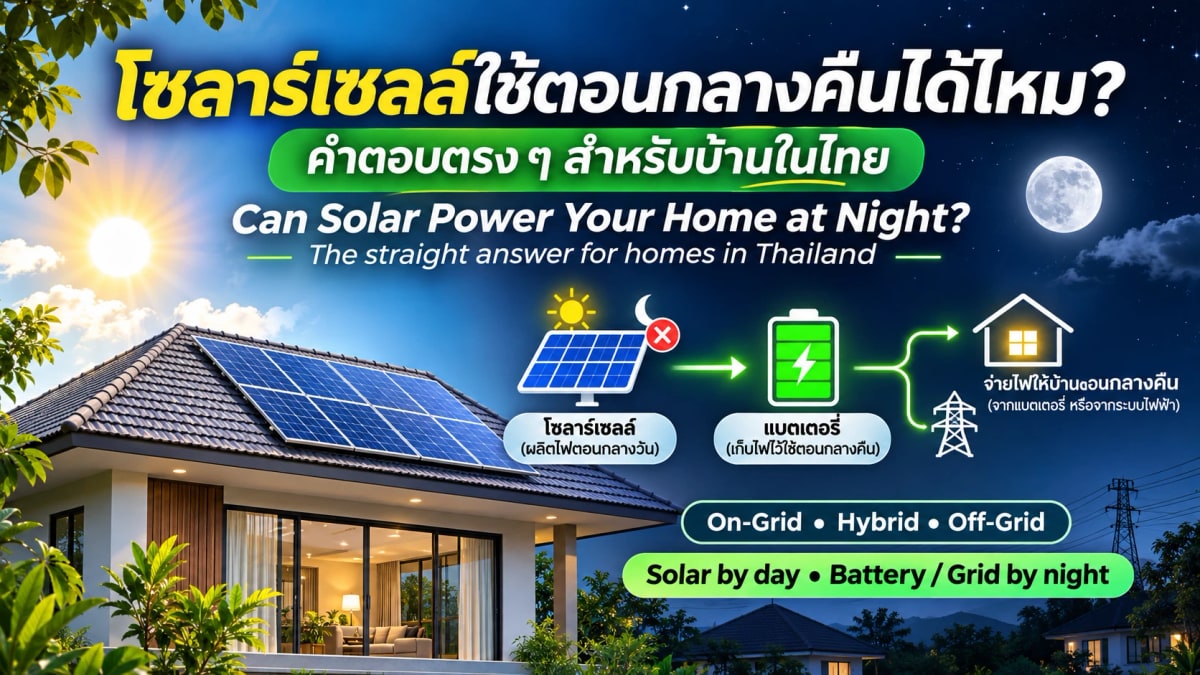
Short answer: solar panels do not generate electricity at night, because they need sunlight. You can still use solar energy after dark, but only if a battery stored it during the day. A home with a standard on-grid system simply buys its night-time electricity from PEA or MEA as usual.
So the useful question is not whether solar works at night. It is where your home gets its power after sunset, and whether a battery fits the way your household uses electricity.
Where Your Power Comes From After Dark
| System | Night-time power | If the stored power runs out | Battery |
|---|---|---|---|
| On-grid | The PEA or MEA grid | Does not apply, as nothing is stored | None |
| Hybrid | Battery first, then the grid | Switches to the grid | Yes |
| Off-grid | Battery only | No power unless there is a generator | Yes, sized for full reliance |
Behaviour depends on how the inverter is configured. Confirm the settings for your own system with your installer.
Most homes in Thailand are connected to the grid, so an on-grid system does not leave you in the dark at night. The panels cut what you buy during the day, and the grid covers the hours without sun. A hybrid system adds a battery so that some daytime solar can be used in the evening instead.
What Uses Most Electricity at Night
- Air conditioning is usually the largest night-time load. A 12,000 BTU inverter unit running for 8 hours typically uses about 3.6–5.2 kWh.
- A refrigerator cycles on and off through the night, averaging roughly 100–150 W.
- Lights, fans, WiFi and standby devices draw little individually, but they add up across a whole night.
Want to run the bedroom AC all night from a battery? We worked through the calculation step by step, from BTU to kWh.
Does Your Home Need a Battery?
- Someone is home in the daytime, or daytime use is high: start by looking at on-grid. Solar is used directly as it is produced, and most grid-connected homes do not need a battery.
- Little daytime use, and the main goal is a lower night-time bill: we do not usually recommend this. At today's battery costs, each unit of electricity from a battery still costs more than buying that unit from the grid.
- Frequent power cuts at home, or payback is not a major concern: this is when we recommend a hybrid system with a battery.
- Do not want to worry now about whether you will add a battery in the future: you can install a hybrid system from the start, so the option stays open.
- No grid connection at the site: off-grid may be the only option, and it needs careful sizing because nothing backs up the battery except a generator.
To assess this properly, have three things ready: your electricity bills, the number and BTU size of your air conditioners, and the hours people are usually at home. Those details show how much of your electricity use actually falls after sunset.
When the Battery Runs Out or It Rains for Days
A grid-connected hybrid system can switch to grid power when the battery reaches its set minimum, so the household keeps running. On overcast days the panels produce less and the battery may not fill, particularly during the Phuket monsoon. In that case a hybrid home draws more from the grid. An off-grid home has no such fallback, which is why its battery and panels must be sized for poor weather.
Not sure whether your home needs a battery? Send us your electricity bill and tell us how you use power at night. Smarter Energy Solution will review it and recommend a system that fits.
Frequently Asked Questions
Do solar panels produce any electricity from moonlight?
Practically none. Moonlight is far too weak to run a home, so treat panel output as zero between sunset and sunrise.
With an on-grid system, will I still pay for electricity used at night?
Yes. On-grid solar reduces the electricity you buy during the day. Anything you use at night still comes from the grid and appears on your bill.
Can a battery run my whole home all night?
It can if the capacity and inverter match your loads, but larger loads need much more storage. Many homes size the battery for chosen circuits, such as bedroom AC, rather than everything in the house.
Is solar still useful if I use most of my electricity at night?
It depends on how much you use during the day. If daytime use is very low, on-grid alone offers limited benefit. We do not usually recommend adding a battery just to cut night-time bills, because each unit from a battery still costs more than buying it from the grid. A battery makes sense if you have frequent power cuts or payback is not a major concern.