
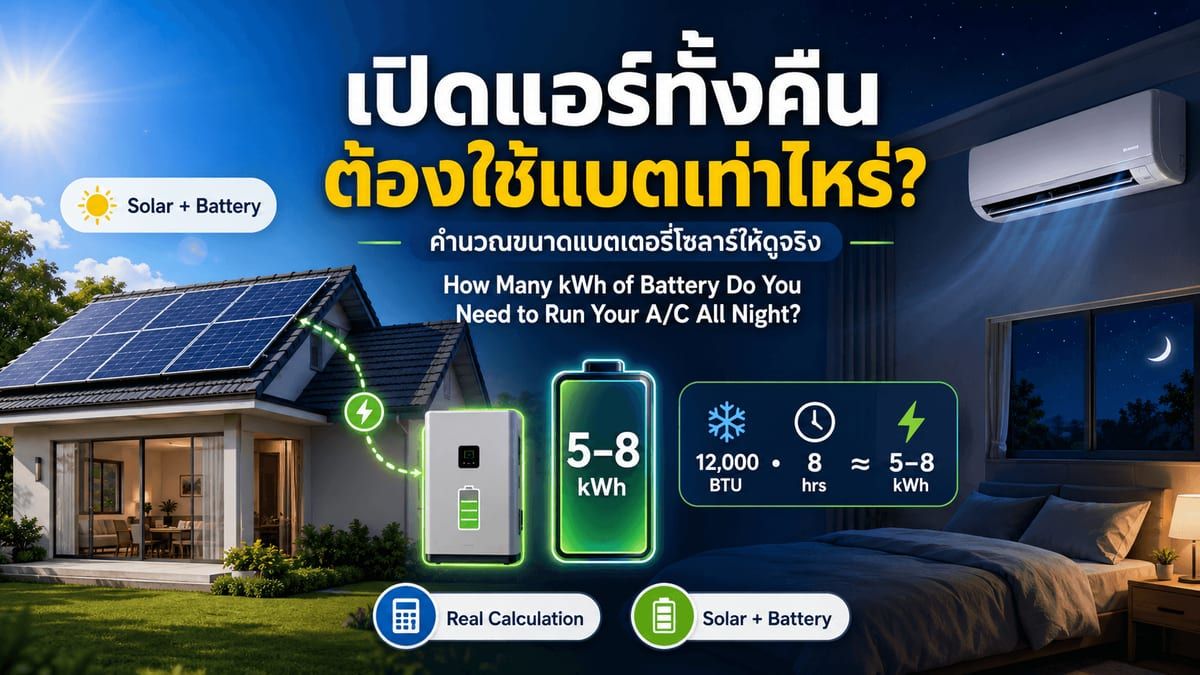
"If I want to run my bedroom AC all night on solar, how many kWh of battery do I need?" is one of the most common questions we get from homeowners considering a hybrid system. The honest answer is: it depends on your AC unit, but it can be calculated — not guessed. This article walks through the actual math, step by step, using real numbers.
Why Air Conditioning Needs Special Battery Sizing
Lights, fans, WiFi routers, and phone chargers draw only a few watts each — they barely register against a battery's capacity. Air conditioning is different: it's usually the single largest continuous load running in a home overnight, and its average power draw depends heavily on the compressor type. Size the battery too small and it drains before sunrise; size it based on a guess and you may pay for capacity you never use.
The 4-Step Calculation
- Step 1 — Find the average steady-state power draw (W) of your AC from its spec label or manufacturer datasheet. Use the average/rated running wattage, not the peak startup wattage, which only lasts a few seconds.
- Step 2 — Multiply that wattage by the number of hours you want it running (e.g. 8 hours overnight) to get the raw energy use in kWh.
- Step 3 — Divide by the hybrid inverter's round-trip efficiency (typically 90–95%) to account for conversion losses between the battery and the AC.
- Step 4 — Divide again by the battery's usable depth of discharge (LiFePO4 batteries are typically usable to about 90% of rated capacity) to get the rated battery size you actually need to buy.
Worked Example: 12,000 BTU Bedroom Inverter AC, 8 Hours
- Average steady-state draw after the room cools down: approximately 500W (0.5 kW) — inverter units modulate down significantly once the target temperature is reached.
- Energy over 8 hours: 0.5 kW × 8 h = 4.0 kWh of raw electrical use.
- Accounting for ~90% inverter efficiency: 4.0 ÷ 0.9 ≈ 4.4 kWh must come out of the battery.
- Accounting for ~90% usable capacity: 4.4 ÷ 0.9 ≈ 4.9 kWh rated battery size — round up to a 5 kWh battery as the bare minimum, with 6–8 kWh giving comfortable margin for hotter nights or an older, less efficient unit.
| AC Size (BTU) | Avg Steady-State Draw (W) | 8-Hour Energy Use (kWh) | Recommended Usable Battery (kWh) |
|---|---|---|---|
| 9,000 | 300–450 | 2.4–3.6 | 5 |
| 12,000 | 450–650 | 3.6–5.2 | 5–8 |
| 18,000 | 700–1,000 | 5.6–8.0 | 8–10 |
| 24,000 (2 ton) | 900–1,300 | 7.2–10.4 | 10–15 |
Typical overnight battery sizing by AC size (inverter-type units, 8-hour run time). Actual draw varies by brand, room size, and insulation — use as a starting estimate.
Inverter AC vs Old On/Off AC — Why the Type Matters
Older on/off compressor units run at full rated power, shut off completely once the room reaches temperature, then restart at full power again — they don't modulate. Averaged over a night, this cycling pattern can draw 30–50% more energy than an inverter-type AC of the same BTU rating. If your home still has an older non-inverter unit, size the battery up from the table above rather than down.
Don't Forget the Other Loads Sharing the Battery
- Refrigerator — cycles on and off, averaging roughly 100–150W over a full night.
- WiFi router / modem — a small but constant draw, roughly 10–20W around the clock.
- Standby loads — TVs, chargers, and other devices left plugged in typically add another 20–50W.
- If your battery backs up more than just the bedroom AC circuit — for example a whole-house backup setup — add these loads into the calculation. A whole-house configuration will need meaningfully more capacity than the dedicated-circuit numbers in the table above.
The numbers above are engineering estimates — actual power draw varies by AC brand, age, room size, and insulation. Smarter Energy Solution can review your AC's spec sheet and real usage pattern to recommend the right battery size for full-night cooling.
Frequently Asked Questions
Can I run AC on a battery overnight without solar panels at all?
Technically yes, by charging the battery from the grid during off-peak hours — but pairing it with solar panels lets the battery charge for free during the day, which is what makes the investment pay back. A battery-only setup without solar rarely makes financial sense.
Does room size affect the battery size I need?
Yes. Larger or poorly insulated rooms make the compressor run harder and longer, raising average power draw. The ranges in this article assume a typical 20–30 sqm bedroom with reasonable insulation — a larger or hotter room may need the next size up.
What if I want to run two AC units overnight?
Add the two units' 8-hour energy-use figures from the table together before dividing by inverter efficiency and usable capacity — don't simply double the recommended battery column, since the two units may have different BTU ratings.
Will battery degradation eventually leave me short of a full night's cooling?
Quality LiFePO4 batteries typically retain 80%+ of their rated capacity even at the end of a 10-year warranty period. Sizing the battery with margin — choosing the next size up rather than the bare minimum — means a few years of gradual degradation won't leave you short.