
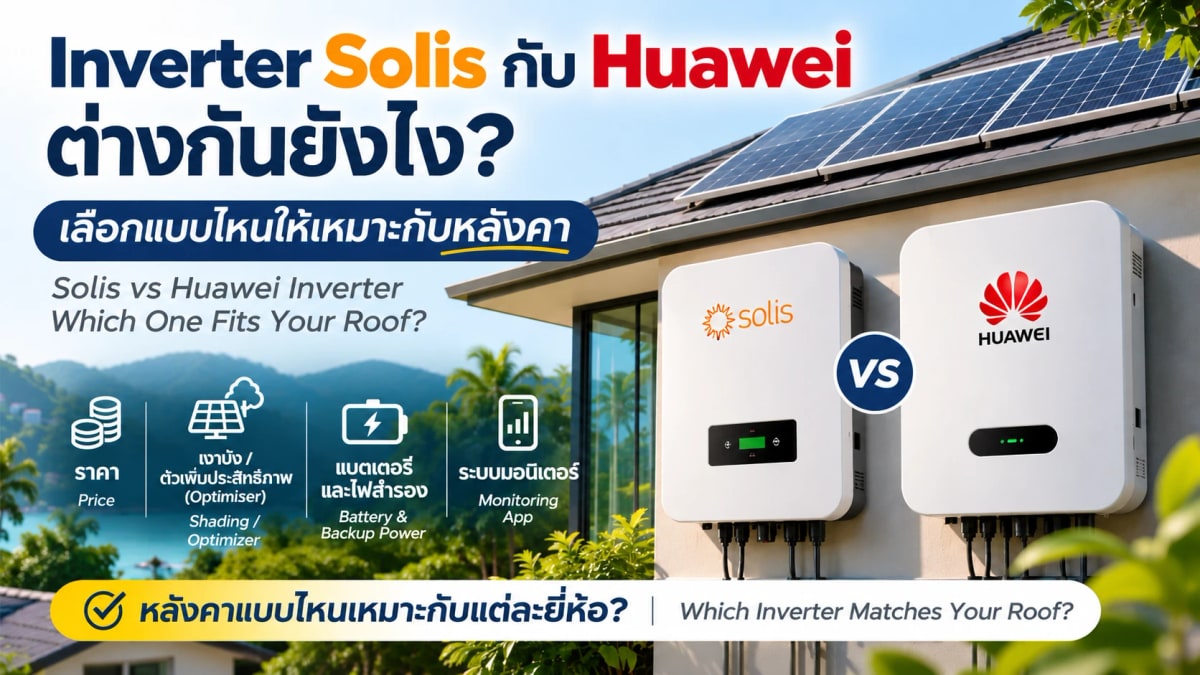
Short answer: both brands work well on most roofs, including shaded ones, because optimizers can be added to either. The real differences are price, battery options and backup output. Solis usually costs less. Huawei suits owners who want its own LUNA2000 batteries. For a three-phase hybrid system, Huawei's M1 series backs up a single phase, while Solis three-phase hybrid models back up all three phases. Smarter Energy Solution uses Solis as its standard specification, so read this comparison with that in mind.
Solis vs Huawei at a Glance
| Solis | Huawei | |
|---|---|---|
| Price level | Mid | Mid to high |
| Optimizers for shading | Can be added | Can be added |
| Batteries | Check the model's approved list | LUNA2000 range on supported models |
| Backup power | Hybrid models with backup output | May need an optional Backup Box, by model |
| Three-phase hybrid backup output | Three phases (S6-EH3P series) | Single phase (M1 series with Backup Box-B1) |
| Monitoring app | SolisCloud | FusionSolar |
| Best suited to | Homes and businesses, including three-phase backup | Owners who want Huawei batteries, large projects |
A general guide. Specifications, accessories and availability vary by model and distributor.
Three-Phase Hybrid: How Many Phases Stay On?
This difference matters for homes and businesses on a three-phase supply. Huawei's three-phase hybrid inverters (SUN2000-M1 series) provide backup through the optional Backup Box-B1, and its backup output is single-phase, around 3 kW. Solis three-phase hybrid inverters (S6-EH3P series) have a three-phase backup output.
- With single-phase backup, equipment that needs three-phase power, such as some pumps, large air conditioners or machinery, will not run during an outage.
- Essential single-phase loads must all be moved onto the one backed-up phase, which limits how much you can keep running.
- With three-phase backup, check how much power each phase can supply on its own, because per-phase limits vary by model.
Shading and Optimizers: Not a Reason to Pick a Brand
Panels connected in series affect one another, so shade on part of a string can reduce its output. An optimizer manages each panel individually to reduce that effect. Huawei sells its own optimizers, but optimizers can also be bought separately and added to systems with other inverter brands, including Solis. So a shaded roof does not mean you need Huawei. Ask your installer to show where shade falls through the day, then decide whether a better layout or optimizers on the affected panels are worth it.
What to Compare in Your Quotation
- Whether optimizers, a smart meter and backup equipment are included or charged separately.
- Which battery models are compatible with the exact inverter proposed.
- Whether the model is accepted by PEA or MEA for grid connection.
- Written warranty terms, and who handles repairs in your area.
Also considering Deye? See how Solis, Huawei and Deye fit different roofs and budgets.
Send us your roof photos or plan. Smarter Energy Solution will check for shading and recommend a suitable inverter, including when another brand may fit better.
Frequently Asked Questions
Do I need Huawei if my roof has shading?
No. Optimizers can be bought separately and added with other inverter brands too, so shading can be handled with either brand.
Is Huawei better than Solis because it costs more?
Not necessarily. Compare what the extra cost buys for your home, such as battery options, monitoring and backup output for your supply phase. For many homes, a well-designed Solis system is the better value.
Can I use a battery with either brand?
Yes, on supported models. Confirm compatibility for the exact inverter and battery. A battery is usually most useful for frequent power cuts, or when payback is not your main concern, rather than only to cut night-time bills.