
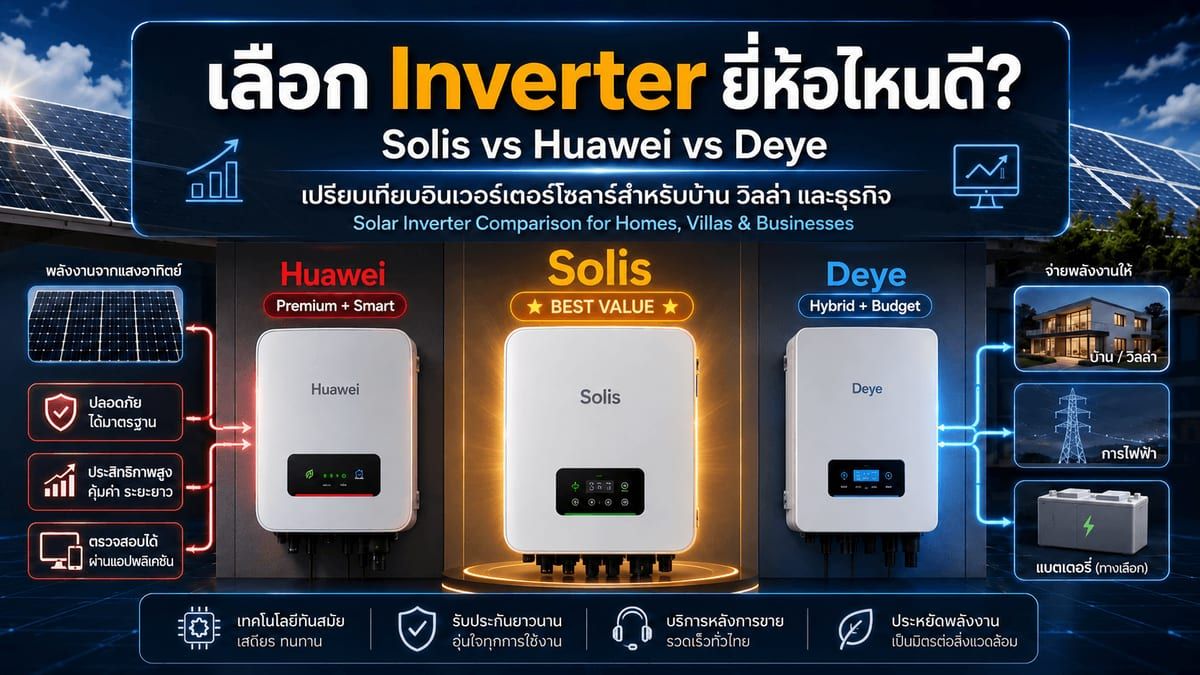
Short answer: there is no single best solar inverter brand for every home. The right choice depends on your roof, whether you want a battery, and your budget. Smarter Energy Solution uses Solis as its standard specification, so read our comparison with that in mind. We also explain below where Huawei or Deye can be the better fit.
- Most homes and businesses that want reliable monitoring and local support at a mid-range price: Solis
- Owners who prefer the Huawei brand and its own LUNA2000 battery range, and accept a higher price: Huawei
- Hybrid system where the lowest total cost is the priority: Deye, after checking local after-sales support
These three brands come up most often when getting solar quotes in Thailand. They sit at different price points and are optimised for different types of installation. The sections below explain what each brand does well, where it falls short, and which property or budget it suits.
Why the Inverter Matters More Than Most People Think
The inverter is the brain of your solar system. It converts DC electricity from the panels into AC electricity your home uses, manages power flow between panels, battery (if fitted), and the grid, and runs the monitoring system that tells you how much energy you are generating and saving. A low-quality inverter can cut system output, fail prematurely, and leave you with no visibility into your system's performance. Choosing the right brand matters as much as choosing the right panels.
Solis — Reliable Performance at a Strong Value
Solis is one of the world's top inverter manufacturers by installed capacity, with full IEC certification and a product range covering residential string inverters, commercial multi-string inverters, and hybrid models for battery systems. The SolisCloud monitoring platform gives system owners and installers real-time visibility into generation, consumption, and grid export. Solis inverters are our standard specification at Smarter Energy Solution because they deliver tier-1 reliability and monitoring capability at a price that keeps payback periods competitive for our customers.
- Strengths: full IEC certification, wide product range (on-grid and hybrid), SolisCloud monitoring app, strong authorised service and parts network in Thailand, competitive price-to-quality ratio
- Considerations: less widely known among end-customers than Huawei; the brand name requires more explanation compared to Huawei's strong consumer recognition in Thailand
- Best for: residential, pool villa, hotel, and commercial installs where strong reliability and real-time monitoring are required at a competitive price
Huawei — Smart Technology with Premium Features
Huawei's SUN2000 series pairs with the FusionSolar app, one of the most detailed monitoring platforms available, and with Huawei's own LUNA2000 battery range on supported models. Huawei also sells module optimisers, but optimisers can be added to systems with other inverter brands too, so shading alone is not a reason to choose Huawei. Its main appeal is strong brand recognition in Thailand and a complete in-house product range.
- Strengths: detailed FusionSolar monitoring app, own LUNA2000 battery range, strong brand recognition in Thailand, wide commercial product range
- Considerations: higher price point than Solis and Deye; on the three-phase M1 hybrid series, backup output through the Backup Box-B1 is single-phase
- Best for: owners who prefer the Huawei brand and its own battery range, large commercial projects, owners who want very detailed monitoring
Deye — Budget-Friendly Hybrid Specialist
Deye has grown rapidly in the Thai market, particularly for hybrid solar systems that combine solar panels with battery storage. Its hybrid inverters are competitively priced and compatible with a wide range of battery brands, making Deye a popular choice when customers want to add battery backup at the lowest total system cost. Monitoring is handled via the SolarmanPV app. For a straightforward hybrid installation where budget is the primary consideration, Deye is worth considering.
- Strengths: competitive price especially for hybrid models, wide battery brand compatibility, growing service network in Thailand
- Considerations: newer brand with shorter track record than Solis or Huawei; monitoring app is less polished; after-sales support infrastructure is still developing in some areas
- Best for: hybrid installations where adding battery storage at the lowest cost is the priority; budget-conscious buyers who understand the trade-off on brand maturity
Side-by-Side Comparison
| Solis | Huawei | Deye | |
|---|---|---|---|
| Price range | Mid | Mid–High | Budget–Mid |
| Origin | China | China | China |
| On-grid range | ✓✓✓ | ✓✓✓ | ✓✓ |
| Hybrid range | ✓✓✓ | ✓✓✓ | ✓✓✓ |
| Optimizers for shading | Can be added | Can be added | Can be added |
| Monitoring app | SolisCloud ★★★★ | FusionSolar ★★★★★ | SolarmanPV ★★★ |
| IEC certified | ✓ | ✓ | ✓ |
| Local service (Phuket) | Good | Good | Developing |
| Best for | Residential / commercial | Huawei ecosystem / large commercial | Budget hybrid |
Solis vs Huawei vs Deye — quick comparison for Thai buyers
Not sure which inverter is right for your property? Our engineers assess your roof, shading conditions, and load profile — and recommend the best inverter for your specific situation. Free, no obligation.
Frequently Asked Questions
Should I choose an on-grid or a hybrid inverter?
If you do not plan to use a battery, on-grid is usually the place to start. We do not usually recommend a battery just to cut night-time bills, because each unit from a battery still costs more than buying it from the grid. A hybrid system suits homes with frequent power cuts or owners who are less concerned about payback. If you do not want to worry now about whether you will add a battery later, you can install a hybrid system from the start.
Does the inverter brand affect my solar warranty?
Yes. Each inverter comes with its own manufacturer warranty — typically 5 to 10 years depending on brand and model. The inverter warranty is separate from the panel warranty (usually 25–30 years for performance). When comparing quotes, check the inverter warranty length and what is covered, and confirm that the installer has access to local service support for that brand.
Can I add a battery to my existing Solis on-grid inverter?
Standard on-grid inverters are not designed to connect to a battery directly. To add battery storage to an existing on-grid system, you would need to replace the inverter with a hybrid model, or add an AC-coupled battery system. Solis offers hybrid inverter models that support battery storage — our team can advise on the most cost-effective upgrade path for your existing installation.
Is a more expensive inverter always better?
Not always. For a simple south- or west-facing roof with no shading, a well-certified mid-range inverter like Solis delivers nearly identical output to a premium brand at a lower cost. On a shaded roof, the usual fixes are a better panel layout or optimisers on the affected panels, and optimisers can be added with other inverter brands too. A good installer recommends the inverter that matches your specific roof — not just the most expensive option available.