
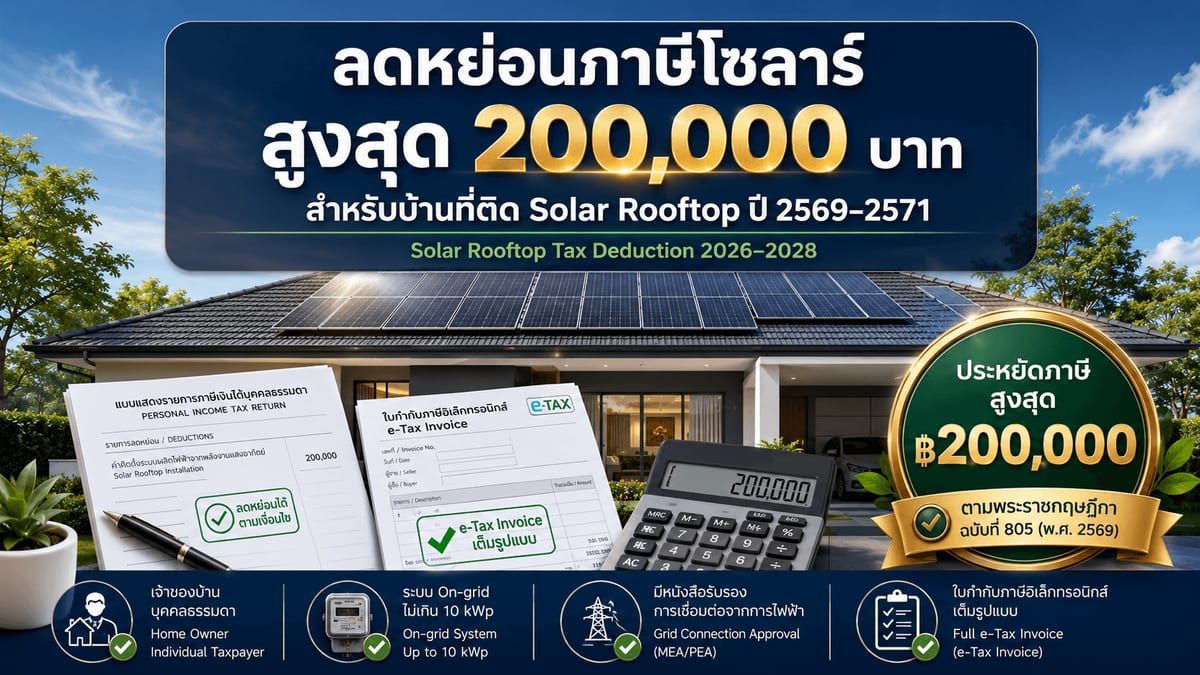
Thailand now has a Royal Decree specifically for rooftop solar: Royal Decree No. 805 (B.E. 2569 / 2026) lets individual taxpayers deduct up to ฿200,000 in personal income tax for installing a residential solar system. Combined with the sell-back program covered in our related article, 2026 has become the most incentive-heavy year yet for Thai homeowners considering solar.
Who qualifies
- Individuals only — not companies or juristic entities. You must file personal income tax.
- You must be the named owner of the electricity meter at the property where the system is installed.
- The system must be grid-connected (on-grid), with a maximum capacity of 10 kWp per household.
- One system and one electricity meter per individual — the deduction cannot be claimed twice for the same person.
Timeline and deduction amount
| Detail | Value |
|---|---|
| Maximum deduction | ฿200,000 (VAT included) |
| Eligible installation period | March 3, 2026 – December 31, 2028 |
| System size cap | Up to 10 kWp per household |
| When to claim | The tax year your system receives grid-connection approval from PEA/MEA |
Based on Royal Decree No. 805 (B.E. 2569). Confirm current details with the Revenue Department before filing.
Update (29 October 2026): you cannot use both this deduction and the government's ฿50,000 People's Solar subsidy for the same system. The official PEA and MEA registration pages state that subsidy recipients must not claim the Royal Decree No. 805 income tax deduction for the solar purchase and installation, in whole or in part. Compare the two before you register — see our article on installing now versus waiting for the subsidy.
Documents you'll need
- A full e-Tax invoice for both the equipment purchase and installation labor — a regular receipt is not enough.
- Proof of grid-connection approval from PEA or MEA for the tax year you're claiming.
- Proof that the electricity meter is registered in your name.
Ask your installer to issue a proper e-Tax invoice from day one — switching to one after the fact is far more difficult than requesting it upfront.
We provide full e-Tax invoices and handle the PEA/MEA grid-connection paperwork for every installation, so you have everything ready when it's time to file. Book a free consultation to see how much you could deduct.
Frequently Asked Questions
Can a company or my business claim this deduction?
No — this deduction is for individual personal income tax filers only, for a system installed at a residential property in their own name. Businesses have separate incentive schemes for solar investment, which are not covered by this decree.
What if my system is bigger than 10 kWp?
The decree caps the eligible system size at 10 kWp per household. Confirm with the Revenue Department or a tax advisor how a larger system affects your specific claim, since this article does not cover every edge case.
Can I combine this tax deduction with the sell-back program?
The two are separate programs — one is a tax benefit from the Revenue Department, the other is a power purchase agreement with PEA/MEA. Based on published information there is nothing preventing a household from applying to both, but confirm your specific situation with each authority.
Can I combine this tax deduction with the ฿50,000 solar subsidy?
No. The official PEA and MEA People's Solar registration pages say subsidy recipients must not claim the Royal Decree No. 805 deduction for the system's purchase and installation, in whole or in part. You have to choose one for that system.