
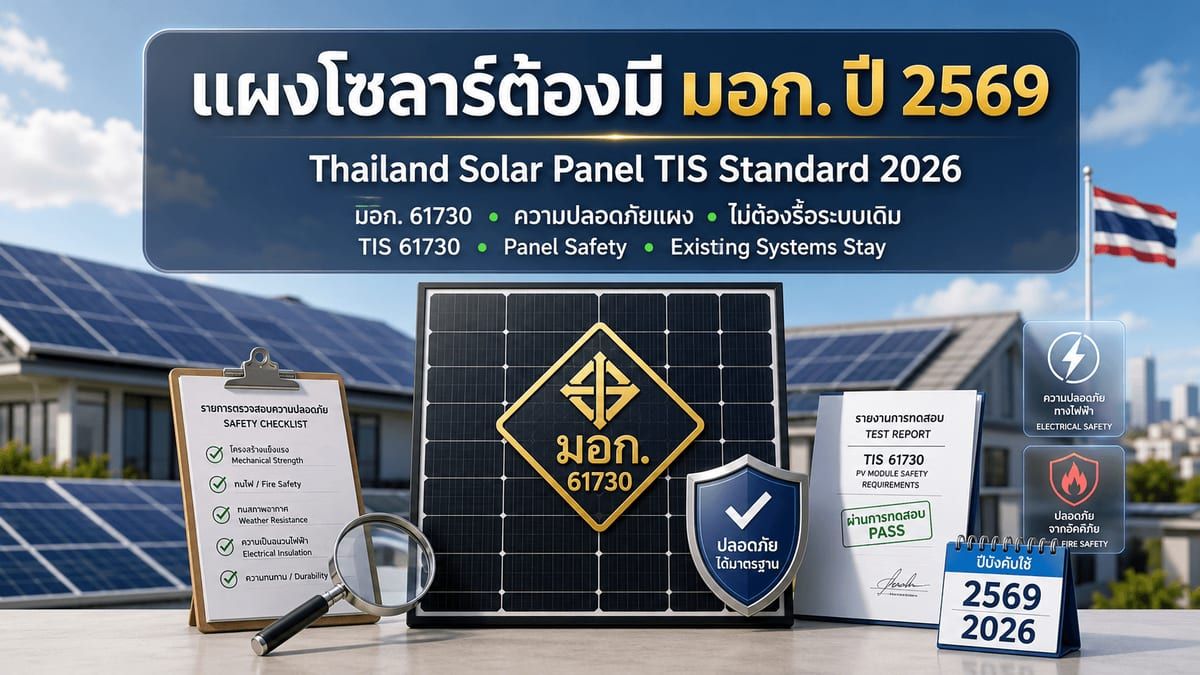
Big news for anyone thinking about solar in Thailand: the government is about to make the TIS safety standard (มอก.) compulsory for solar panels. The Industrial Standards Council (กมอ.) approved TIS 61730 Part 2-2567 in May 2026, and the Thai Industrial Standards Institute (สมอ.) is expected to enforce it as a controlled product around September 2026. This article explains — in plain language — what TIS actually checks, why it matters for safety, and the question we get asked most: "If I already installed solar, do I have to tear it out?"
What is TIS (มอก.) — and "general" vs "compulsory"
TIS (Thai Industrial Standard, "มอก.") is a certification issued by the Thai Industrial Standards Institute (สมอ.) confirming a product passed required tests. There are two kinds: a "general" standard is voluntary — a maker can apply for it but isn't forced to. A "compulsory" standard is backed by law: it becomes illegal to manufacture, import, or sell that product without a TIS licence. Solar panels have been on the voluntary list for years. What's changing is that panel safety is moving to the compulsory list.
Timeline: when do solar panels need TIS?
| When | What happens |
|---|---|
| May 2026 (พ.ค. 2569) | กมอ. เห็นชอบ มอก. 61730 เล่ม 2-2567 (ความปลอดภัยแผง) — Standards Council approves the panel-safety standard. |
| ≈ Sep 2026 (≈ ก.ย. 2569) | คาดบังคับใช้ — แผงเป็นสินค้าควบคุม ทุกแผงที่ผลิต/นำเข้า/ขายต้องมีใบอนุญาต มอก. — Expected enforcement: panels become a controlled product. |
| Early 2027 (ต้นปี 2570) | เป้าขยายมาตรฐานบังคับทั้งระบบ (อินเวอร์เตอร์ สาย แบต ฯลฯ) — Target to extend compulsory standards to the whole system. |
Dates are the authorities' announced targets; the exact enforcement date is set 120 days after publication in the Royal Gazette. Confirm current status with สมอ. (hotline 1441).
What does TIS test to pass?
A solar panel must pass two TIS books, built directly on the international IEC standards. Think of them as two different questions: "Does it still make power after years of abuse?" and "Is it safe — no shocks, no fire?"
| Standard | What it tests for |
|---|---|
| มอก. / IEC 61215 | สมรรถนะ & ความทนทาน · Performance & durability |
| มอก. / IEC 61730 | ความปลอดภัยไฟฟ้า & ไฟไหม้ · Electrical & fire safety |
TIS 61215 = performance/durability. TIS 61730 = safety (the book becoming compulsory).
TIS / IEC 61215 (performance) puts a panel through accelerated ageing, then checks it still makes power. It must keep at least 95% of its rated output after:
- Damp heat — 85°C at 85% humidity for 1,000 hours
- Temperature cycling — −40°C to +85°C, 200 cycles
- Mechanical load — ~2,400–5,400 Pa of wind/snow pressure
- Hail impact — a 25 mm ice ball at ~23 m/s
- Hot-spot from partial shade (e.g. leaves, bird droppings)
TIS / IEC 61730 (safety) — the book becoming compulsory — checks that no one gets shocked and the panel won't start a fire:
- Wet-leakage current — ≤50 μA/kV when wet
- Dielectric withstand + impulse voltage (lightning/surge)
- Ground / equipotential continuity
- Sharp-edge test (safe to handle and install)
- Fire / flame-spread class (A / B / C)
This is why cheap, uncertified panels are a real risk: they most often fail on wet-leakage, hot-spot, and flame-spread — the exact failures behind the rooftop fires that pushed the government to make the standard compulsory.
Already installed solar — do you have to remove it?
Short answer: no. The law controls three actions only — manufacturing, importing, and selling. Its target is makers, importers, and shops, not end-users who already own and operate a system. So a home or business that installed solar before the enforcement date is not committing an offence, and this type of compulsory-standard law does not reach back to order already-installed systems torn out. (For full legal certainty on your specific case, confirm with สมอ. 1441.)
That said, the change still touches existing systems in three indirect ways:
- Repairs & replacements: if a panel needs replacing after the date, the new panel you buy must carry TIS — shops won't be allowed to sell non-TIS panels.
- Resale & insurance: when you sell the property or arrange insurance / ESG reporting, certified equipment with documentation is an advantage.
- Old stock: any non-TIS panels still sitting in a shop's inventory can't legally be sold after the deadline — this affects installers more than homeowners.
What other equipment is next?
Panels go first, but the authorities have signalled the whole system will follow. Standards in the pipeline cover:
- DC circuit breakers
- Fuses for PV systems
- PV cables
- Lithium batteries for energy storage
- PV combiner boxes
- DC connectors (MC4)
Grid-tied inverters already have their own separate standard (TIS 2607-2563).
How to spot a panel that has TIS
- Look for the official TIS mark (a diamond-shaped symbol) printed on the panel label, alongside a licence number.
- The label should reference the standard number — e.g. TIS 61730 and/or TIS 61215.
- An international IEC / CE / TÜV certificate is good, but it is NOT the same as a Thai TIS licence — ask the supplier specifically for the TIS licence document for the exact model.
- Verify a brand or importer in the สมอ. licence database (a.tisi.go.th) or by calling 1441.
Not sure if your panels — or the panels a contractor is quoting — meet the new TIS rule? We help homeowners and businesses in Phuket choose compliant, certified equipment and install to PEA/MEA standards. Book a free consultation and we'll walk you through it.
Frequently Asked Questions
When exactly does the TIS rule for solar panels start?
The council approved the safety standard (TIS 61730 Part 2-2567) in May 2026, and สมอ. is expected to enforce it as a controlled product around September 2026. The precise date is fixed 120 days after the announcement is published in the Royal Gazette, so confirm the latest status with สมอ. (1441) before relying on a specific day.
I installed solar last year. Do I need to do anything?
No action is required — the law targets making, importing, and selling panels, not systems already in use. Just keep your equipment documents. If you replace a panel in the future, make sure the new one carries TIS.
Does an IEC or CE certificate count as TIS?
No. IEC, CE, UL, and TÜV are international certificates and TIS is built on the same IEC tests — but the Thai compulsory law requires an actual TIS licence issued by สมอ. for the specific model. Passing IEC makes getting TIS easier, but they are separate documents.
Will TIS panels cost more?
There may be some upward pressure on prices during the transition as the market shifts to certified-only stock, but the trade-off is real safety and quality assurance — and protection from the fire and performance risks of substandard panels. Ask your installer for current pricing on TIS-compliant options.