
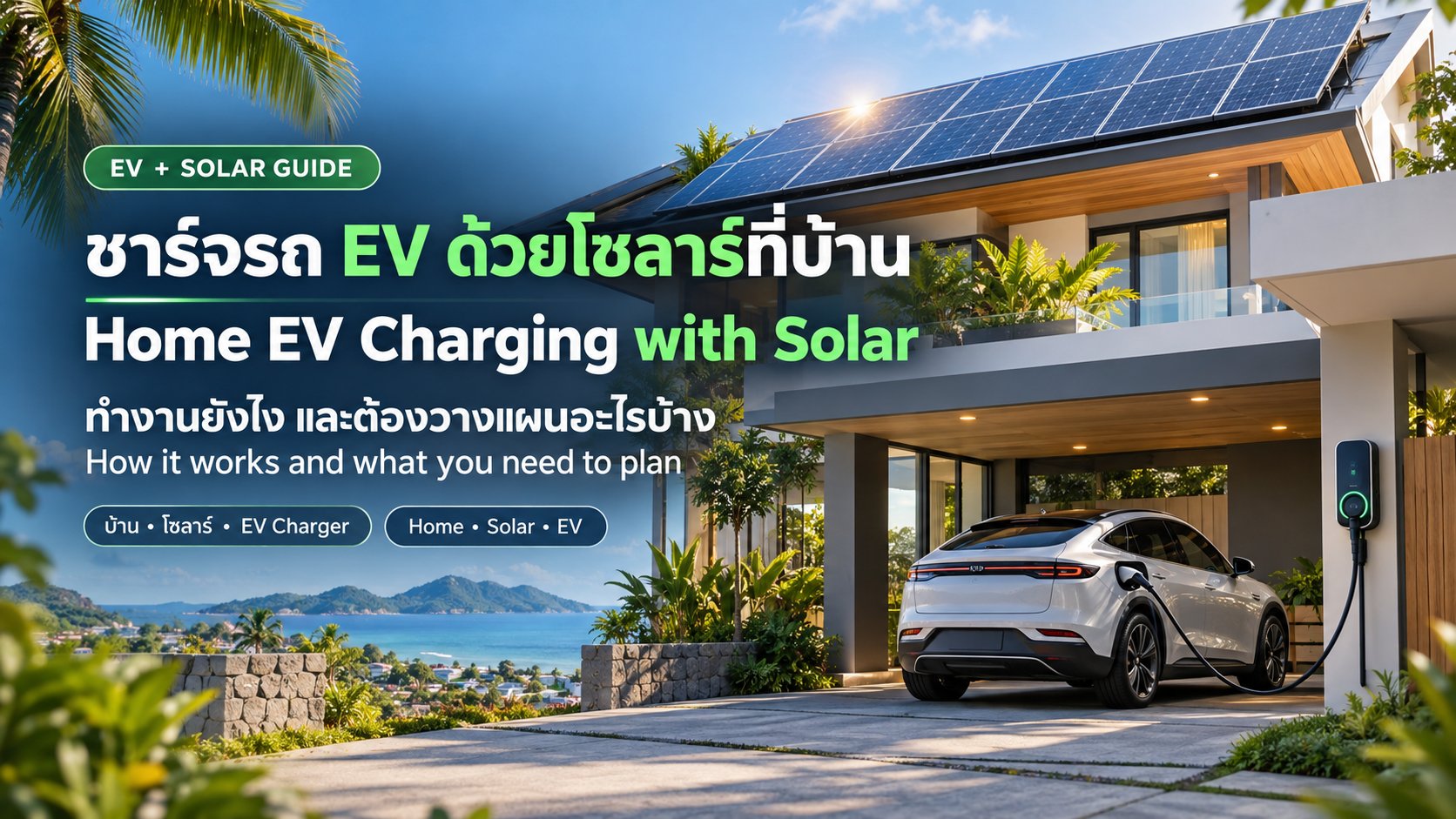
More homeowners in Phuket are pairing an EV with their solar system — it feels like the natural next step once you're already generating your own power. But "charging my EV with solar" means different things depending on how your system and charging habits are set up. Here's how it actually works.
How Home EV Charging Draws Power
A regular wall outlet (Level 1) charges very slowly — often adding only 1–2 kW, which can take a full day or more for a meaningful charge. Most homes with an EV install a dedicated Level 2 home charger instead, typically 7 kW on a single phase or up to 22 kW on three-phase power. A 7 kW charger alone can draw more power than many household solar arrays produce at once, so it's worth checking your home's electrical service capacity and your solar system's size before assuming the charger will run entirely on sunshine.
- Charging during the day, while your panels are producing, lets the EV use solar power directly — the same self-use value (฿3.86/unit saved) as any other daytime appliance
- Charging at night draws from the grid (at retail rate) unless you have a battery sized to store enough daytime surplus for the charge
- Other daytime loads (AC, pool pump) compete with the EV charger for the same solar output — if your array is already fully used by the house, the EV mostly draws from the grid even at noon
| Scenario | Effective Cost | Needs Battery? |
|---|---|---|
| Daytime direct from solar · ชาร์จกลางวันตรงจากโซลาร์ | ≈ ฿0 marginal cost · ≈ ต้นทุนส่วนเพิ่มเกือบ 0 บาท | No · ไม่ต้อง |
| Night, via stored battery · กลางคืน ผ่านแบตเตอรี่ที่เก็บไว้ | Cost of the battery system, amortized · ต้นทุนระบบแบตเตอรี่ (เฉลี่ยตามอายุใช้งาน) | Yes · ต้อง |
| Night, from the grid · กลางคืน จากกริดโดยตรง | ฿3.86/unit · 3.86 บาท/หน่วย | No · ไม่ต้อง |
Rough cost per kWh delivered to the car, by charging scenario
A Rough Sizing Example
Most electric cars use roughly 150–200 Wh per km driven, depending on the model and driving style. For a 40 km daily round trip — a common commute distance in and around Phuket town — that works out to about 6–8 kWh per day. To cover that from daytime solar alone, your system needs enough spare production, after the house's own daytime use, to generate that extra 6–8 kWh during sunlight hours — roughly the output of 2–3 additional 550W panels on a clear day, though actual results vary with weather and household consumption patterns.
Planning to add an EV soon? Tell us your daily driving distance when you request a quote, and we'll size the system with EV charging in mind from the start.
Frequently Asked Questions
Do I need a special EV charger, or can I just use a regular outlet?
A regular outlet works but charges very slowly (Level 1). Most EV owners install a dedicated Level 2 home charger for practical daily charging — have an electrician confirm your home's wiring and breaker can handle the extra load before installing one.
Does EV charging affect my solar sell-back program limits?
The export limit under the sell-back program applies to power you send out to the grid, not power you draw in. Charging an EV consumes power rather than exporting it, so it doesn't reduce your export quota — though it does reduce how much surplus you have available to export in the first place.
Should I size my solar system bigger specifically for the EV?
It depends on your daily driving distance and whether you plan to charge mostly during the day. If you commute a long distance daily and want most of that to come from solar, sizing extra panel capacity for the EV from the start is usually more cost-effective than adding panels later. Share your typical driving pattern with your installer so they can size it correctly.