
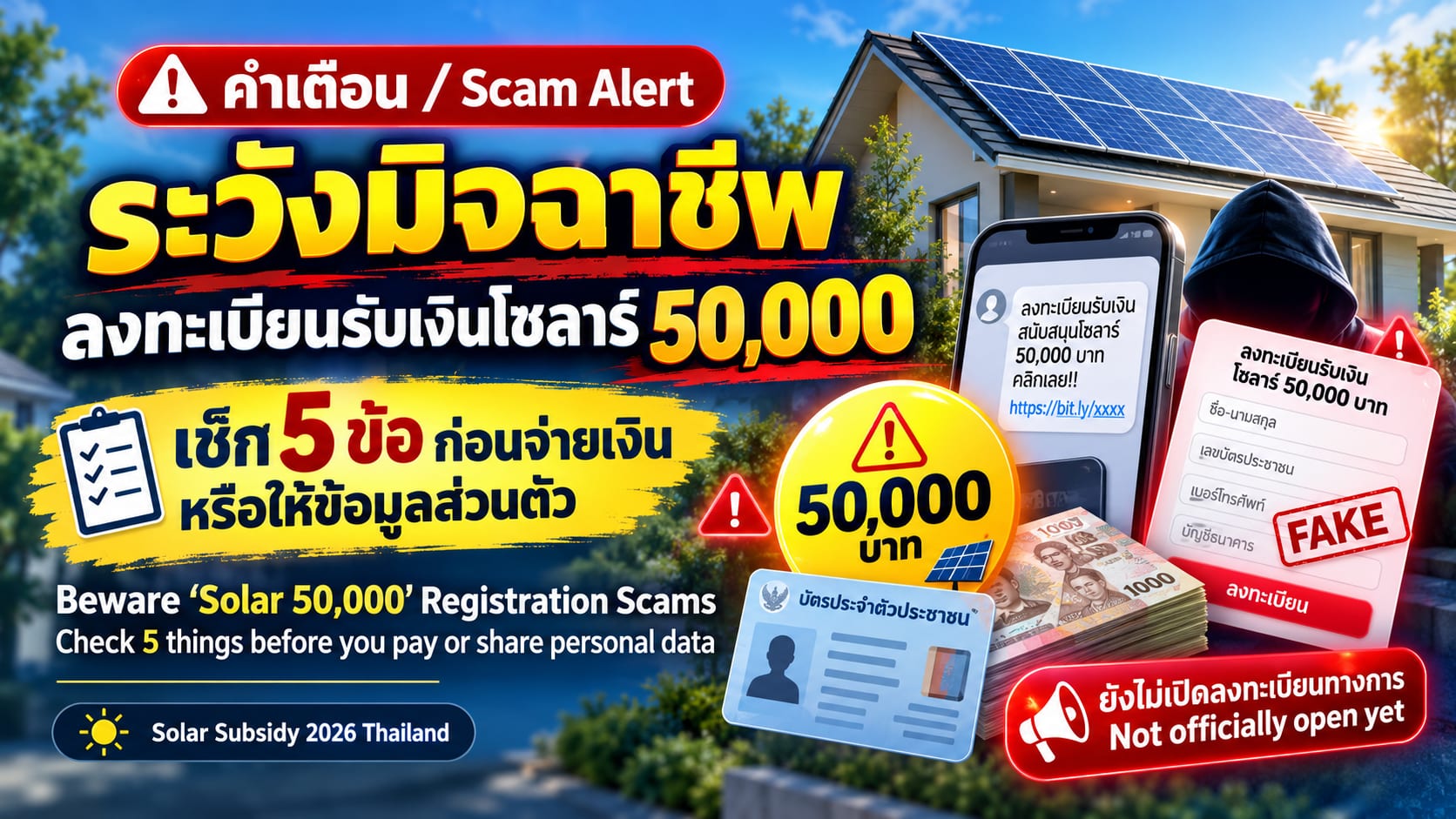
The government's planned "People's Solar" scheme — a ฿50,000 subsidy per household for installing solar — is one of the most talked-about topics in Thailand right now. Whenever a large cash benefit is announced before the rules are final, people start offering to "register you early", "reserve your right" or "guarantee the ฿50,000". This article explains what is actually known so far and gives you five simple checks before you pay anyone or share your personal details.
As of 16 October 2026, registration has NOT officially opened. News reports (1–2 October 2026) say the Ministry of Interior expects to open registration around 1 November 2026, subject to an official announcement. Until that announcement, nobody can register you or guarantee you the subsidy.
What has been reported so far
- On 1 October 2026 the Prime Minister, as Interior Minister, signed a proposal to use ฿75 billion of loan funding for the scheme — about 1 million households in the first phase and 500,000 more later. It still has to go through a review committee.
- Reported terms: ฿50,000 per household, for sites that already have an electricity meter; systems of 5–10 kW on a roof, on the ground, or floating; surplus power bought back for up to 5 kW at ฿2.20/kWh on a contract of about 20 years.
- Financing: three state banks (GHB, GSB and BAAC) are reported to offer loans at 2.5% a year over about 7 years, repaid from the income of selling power back.
- Installers: reports say installers must be registered on the electricity authorities' vendor list and meet standards for track record, engineers and financial stability. You can buy through the electricity authority or from a registered private company.
All of the above comes from news reports, not a published official rulebook — amounts, eligibility and dates can still change. For background on whether to wait for the scheme at all, see our article on installing now versus waiting for the subsidy.
Warning signs to watch for
- "Registration is already open — pay us and we'll get you in before the quota fills."
- "We guarantee you'll get the ฿50,000" — or a quotation that already deducts ฿50,000 from the price as if it were certain.
- A "registration fee", "queue fee" or "processing fee" to apply on your behalf.
- A link sent by SMS, LINE or social media that claims to be the electricity authority or a government agency and asks you to log in, enter bank details or an OTP.
- Pressure to decide today, payment to a personal bank account, or a "company" with no address you can visit.
5 checks before you pay or share personal data
- 1. Has registration officially opened? Check the announcement yourself on official channels — the Ministry of Interior, PEA (pea.co.th, the utility for Phuket and most provinces), MEA (mea.or.th, for Bangkok, Nonthaburi and Samut Prakan) or the state banks. If there is no official announcement, nobody can "register you early".
- 2. Don't pay a fee just to be registered. Nothing reported so far mentions a registration fee. If someone asks for one, ask them which official announcement it is based on — and treat "I can't show you" as a no.
- 3. Protect your personal data. Never share an OTP, online-banking password or PIN with anyone. Only give a copy of your ID card or house registration for a real, signed installation contract — and write on the copy what it is for and the date.
- 4. Check that the installer is real. Look for a registered company name and tax ID, an office address you can visit, completed projects you can see, and a written quotation with equipment brands and warranties. Once the official vendor list is published, check the installer is on it if you plan to use the scheme.
- 5. Separate the solar contract from the subsidy promise. A deposit is a normal part of a real installation contract — but pay it to the company's bank account, against a signed contract, and make sure the quotation shows the full price without the subsidy. Ask in writing what happens if you turn out not to qualify.
If you think you've been scammed
- Contact your bank immediately to try to stop or trace the transfer, and change any passwords you may have shared.
- Report it to the police — Thailand's online crime reporting site is thaipoliceonline.go.th — and keep screenshots of chats, links and transfer slips.
- Tell family and neighbours, especially older relatives — this kind of offer often spreads person to person.
Want honest advice while the rules are still unclear? Book a free survey — we'll size a system from your real bills and quote the full price, without counting a subsidy that isn't confirmed. We can't guarantee anyone the ฿50,000; eligibility depends on the official rules.
Frequently Asked Questions
Is registration for the ฿50,000 solar subsidy open now?
Not as of 16 October 2026. News reports say registration is expected around 1 November 2026, subject to an official announcement. Check official channels rather than relying on messages or ads.
Can an installer reserve my subsidy for me in advance?
Until official registration opens, there is no published system for reserving a right. Anyone claiming to reserve or guarantee it should be able to show you the official announcement it is based on.
Is paying a deposit to an installer always a red flag?
No — a deposit is normal for a real installation contract. The red flags are paying without a signed contract, paying into a personal account, or a deposit that depends on a promise that you will receive the subsidy.
Is this the same as the existing ฿2.20/kWh sell-back programme?
No. The existing People's Solar sell-back programme has accepted applications since 1 July 2026 and pays for surplus power, but has no installation subsidy. The ฿50,000 scheme is a separate plan that has not opened yet. See our article on the sell-back programme for how it works.