
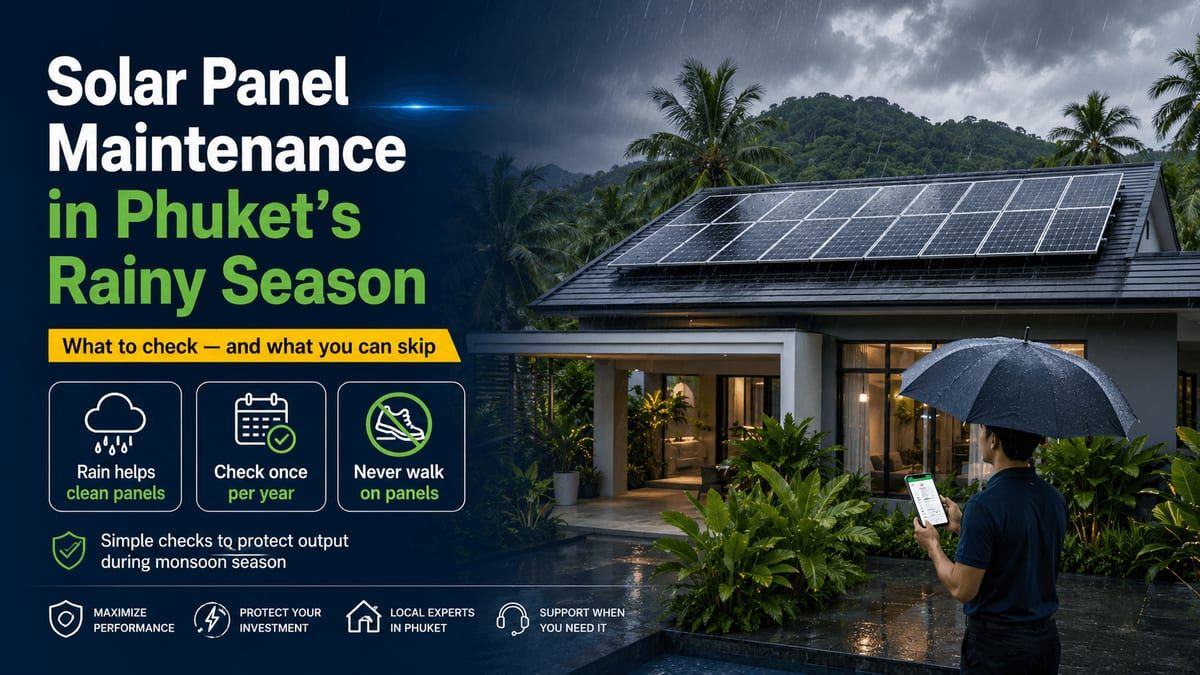
Good news first: solar panels require very little maintenance. The rainy season (May–October) in Phuket actually helps — heavy rain washes dust and debris off the panels automatically. But there are a few things worth checking once a year to catch issues early and protect your investment.
What the Rain Does For You (For Free)
- Washes away dust, pollen, and light bird droppings — the main cause of output loss on dry-season panels
- Cools panel surfaces — panels produce slightly more power at lower temperatures
- No need to manually clean panels that receive regular heavy rainfall
Annual Checks — Do These Once Per Year
- Check panel output in your inverter app — compare monthly kWh generation this year vs last year. A drop of more than 10% (beyond normal monsoon cloud effect) may indicate a fault.
- Inspect panel surfaces for cracks, hotspots, or discolouration — do this from ground level with binoculars or from a safe vantage point. Do NOT walk on panels.
- Check mounting brackets and roof penetrations — verify no rust, loose bolts, or sealant cracking that could allow water ingress
- Inspect inverter indicator lights — your inverter should show a steady green or blue light during daylight operation. Flashing red or error codes should be investigated promptly.
- Clear debris from panel edges and drainage channels — fallen leaves and branches can block water flow and trap moisture
After a Severe Storm
- Visually inspect from ground for visible panel damage or shifted mounting rails
- Check inverter output the following day — production should return to normal once sun returns
- If panels were hit by debris or you notice any damage — contact your installer before attempting any repairs yourself
What NOT To Do
- Do not walk on panels — they are not designed to bear weight and can crack invisibly
- Do not use high-pressure water jets — may damage frame seals and push water inside the junction box
- Do not use abrasive cleaners or metal tools — scratches reduce light transmission permanently
- Do not ignore error codes on your inverter app for more than 2–3 days
All Smarter Energy Solution installations include a system performance guarantee. If you notice a drop in output or any fault codes, contact us — we offer after-sales support and annual inspection services.
Frequently Asked Questions
How often should I clean my solar panels in Phuket?
In Phuket, the rainy season (May–October) keeps panels relatively clean. A light rinse with fresh water at the start of the dry season (November) and once mid-dry-season (February) is usually sufficient. Panels near busy roads or with bird activity may need more frequent cleaning.
Does humidity in Phuket damage solar panels?
Quality IEC-certified panels are sealed and rated for tropical humidity (IP67 or IP68 junction boxes). Salt air near the coast is worth monitoring — aluminium frames and stainless steel fasteners are standard on all panels we install.
My inverter shows a grid fault during heavy rain — is this normal?
Brief grid fault errors during storms are common — lightning can cause momentary grid voltage fluctuations. The inverter disconnects for safety and reconnects automatically when voltage stabilises (usually within minutes). If faults persist for hours after the storm, contact us.
Do I need a professional inspection every year?
A professional inspection every 2–3 years is a good practice, or sooner if you notice any output drop or fault codes. Annual visual checks by the owner (from ground level) plus monitoring your inverter app monthly is sufficient for most systems.