
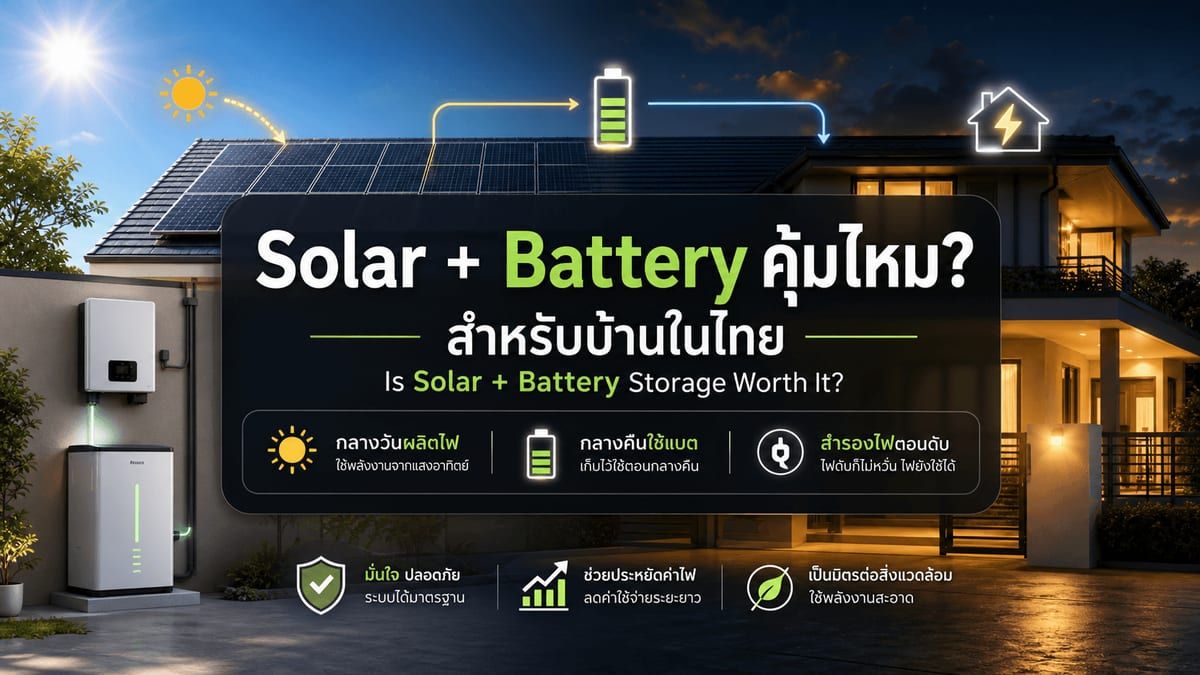
Solar panels have become a familiar sight on rooftops across Thailand — but more homeowners are now asking about the next step: adding a battery. A solar battery system stores the excess energy your panels produce during the day so you can use it at night or during a power cut. It sounds ideal. But the real question is whether the extra investment makes financial sense for a typical Thai household.
What is a Solar Battery Storage System?
A home solar battery (most commonly lithium iron phosphate — LiFePO4) connects to your solar inverter and stores electricity that would otherwise be exported back to the grid or wasted. When the sun goes down, the battery discharges to power your home instead of drawing from PEA. A hybrid inverter manages the flow automatically: solar first, battery second, grid as backup.
On-Grid vs Hybrid Solar — What's the Difference?
| Feature | On-Grid (Solar Only) | Hybrid (Solar + Battery) |
|---|---|---|
| Daytime savings | ✅ Yes | ✅ Yes |
| Evening / night savings | ❌ No | ✅ Yes |
| Works during blackout | ❌ No (shuts off) | ✅ Yes (with backup mode) |
| Exports excess to grid | ✅ Yes | ✅ After battery is full |
| System cost | Lower | Higher (+30–60%) |
| Payback period | 4–7 years typical | 6–10 years typical |
| Best for | High daytime usage | Evening-heavy users or outage-prone areas |
Key differences between on-grid and hybrid solar systems
When Does Adding a Battery Actually Make Sense?
A battery is not the right choice for every home. It makes the most financial and practical sense in these specific situations:
- Evening-heavy household — if most of your electricity usage happens after 6 PM (cooking, TV, air conditioning overnight), a battery lets you run on stored solar instead of PEA peak-rate power
- Frequent power cuts — areas outside Phuket's city centre (Thalang, Kathu, rural Phang Nga) can experience seasonal outages; a hybrid system keeps essential loads running
- Home office or critical equipment — if downtime costs money (freezers, medical equipment, work servers), backup power has real financial value beyond the electricity savings alone
- Maximising self-consumption — if you generate more solar than you use during the day but pay full tariff at night, a battery captures that surplus for you instead of selling it back cheaply
Battery Cost and Payback Estimates for Thai Homes
| Battery Capacity | Typical Use Case | Approx. Battery Cost (THB) | Added Monthly Saving | Extra Payback |
|---|---|---|---|---|
| 5 kWh | Small house, evening top-up | 80,000–120,000 | 600–1,000 | 8–12 years |
| 10 kWh | Medium house, full-night coverage | 150,000–220,000 | 1,200–2,000 | 7–10 years |
| 15–20 kWh | Large house or villa, full backup | 250,000–380,000 | 2,000–3,500 | 7–10 years |
Estimates for LiFePO4 home battery added to an existing or new solar system. Actual costs and savings depend on usage patterns, system size, and installer. Prices as of mid-2026.
Note: These estimates cover the battery and hybrid inverter only — not the solar panels, which are quoted separately. Combined solar + battery systems for a typical Thai home start at approximately 250,000–450,000 THB depending on system size.
What to Look for in a Home Battery
- Chemistry: LiFePO4 (lithium iron phosphate) is the safest and most durable option for home use — significantly better than older NMC chemistry for cycle life and thermal stability
- Cycle life: Look for 4,000+ cycles at 80% depth of discharge — this translates to 10+ years of daily use
- Usable capacity vs rated capacity: A 10 kWh battery typically has 8–9 kWh usable — ask for the usable figure, not just the label
- IP rating: In Thailand's humid climate, look for IP55 or higher for batteries installed outdoors or in open utility rooms
- Warranty: Reputable brands offer 10-year product warranties with capacity guarantees (e.g. ≥80% capacity retention at end of warranty)
- Compatibility: Battery must be compatible with your hybrid inverter brand — not all batteries work with all inverters
Smarter Energy Solution supplies and installs DYNESS LiFePO4 home batteries — one of the most widely deployed residential battery brands in Southeast Asia. Our team can assess whether adding battery storage makes sense for your home and usage profile.
Frequently Asked Questions
Can I add a battery to my existing on-grid solar system in Thailand?
It depends on your current inverter. Standard string inverters cannot be retrofitted with a battery directly — you would need to replace the inverter with a hybrid model or add an AC-coupled battery system. A site assessment will determine the most cost-effective upgrade path.
Is a solar battery system safe to install inside my home?
Modern LiFePO4 batteries are significantly safer than older lithium chemistries — they do not catch fire under normal operating conditions and have excellent thermal stability. They are typically installed in a garage, utility room, or covered outdoor area with adequate ventilation. Proper installation by a certified electrician is essential.
Does Thailand have a feed-in tariff that affects battery economics?
Thailand's residential solar feed-in tariff (the VSPP programme) pays a rate well below what you pay PEA to import electricity. This means storing excess solar in a battery and using it yourself is almost always more economically attractive than exporting it. Confirm current rates with your installer before finalising your system design.
How long does a home battery last in Thailand's climate?
Quality LiFePO4 batteries rated for 4,000+ cycles will last 10–15 years with daily use in Thailand's climate, provided they are installed away from direct sun and extreme heat. High ambient temperatures do accelerate battery degradation slightly — installing the battery in a shaded, ventilated location is recommended.