
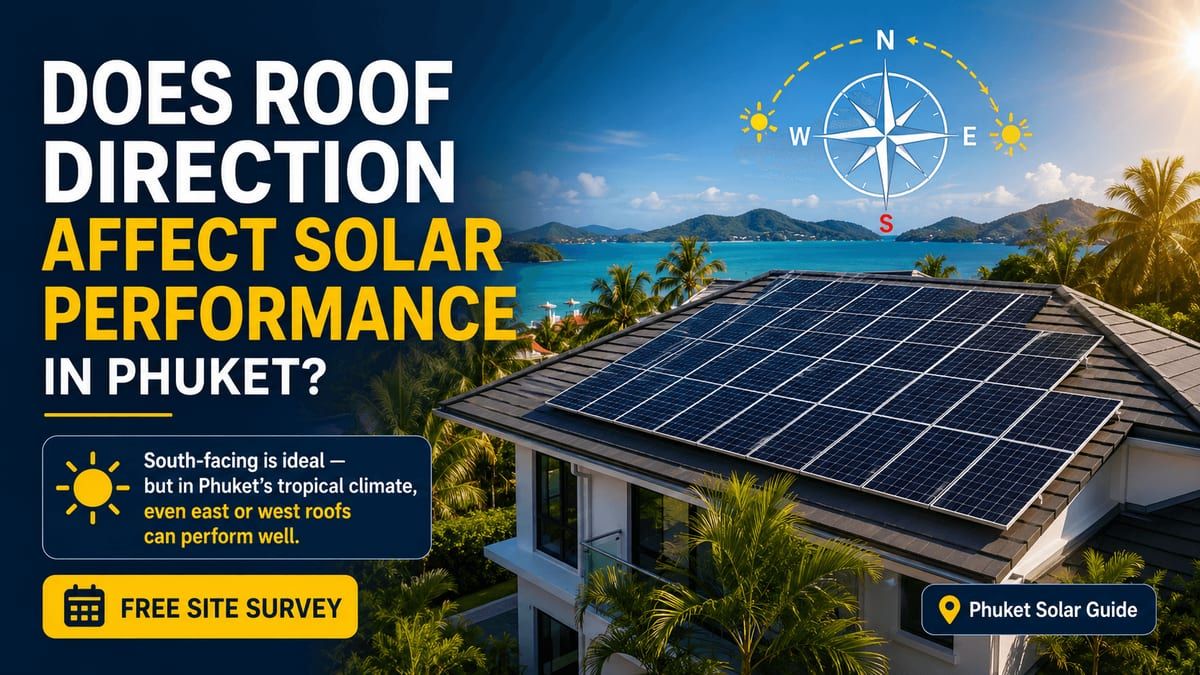
One of the first questions homeowners ask before installing solar is: "Does my roof face the right direction?" The short answer is yes — direction does matter. But in Phuket specifically, it matters less than you might think. Here's why.
Which Direction is Best for Solar in Thailand?
Thailand is in the northern hemisphere close to the equator. The sun travels across the southern sky, which means south-facing panels collect the most sunlight over the course of a day.
| Direction | Production % | Best For | Notes |
|---|---|---|---|
| South | 100% | All system types | Ideal — maximum annual yield |
| East | 80–85% | Morning-heavy users | Strong morning output, drops in afternoon |
| West | 80–85% | Afternoon-heavy users | Peak output matches afternoon peak tariff |
| North | 60–70% | Not recommended alone | Lowest output — use only if no other option |
Approximate annual production relative to south-facing (100%)
What Makes Phuket Different?
Phuket receives over 5 peak sun hours per day on average — one of the highest in Thailand. The monsoon season (May–October) reduces output during cloudy days, but modern monocrystalline panels still generate 20–30% of rated power under heavy cloud cover. More importantly, Phuket's latitude (8°N) means the sun is nearly overhead for much of the year, reducing the penalty for non-south-facing roofs compared to further-north locations.
Can You Still Install Solar with a Non-South-Facing Roof?
Yes — absolutely. At Smarter Energy Solution we regularly install on east, west, and even mixed-direction rooftops. There are several techniques to maximise performance:
- Split-string inverter design — panels on east and west slopes feed separate strings, so shading on one side does not reduce the other
- Tilt frame mounting — on flat roofs or low-pitch roofs, adjustable tilt frames angle panels toward the south at 10–15°
- Micro-inverters or DC optimisers — each panel works independently, eliminating the performance drag from mixed-orientation arrays
What Matters More Than Roof Direction
- Shading — trees, water tanks, or neighbouring buildings blocking even 10% of a panel can cut output by up to 30% on a standard string inverter. A shading analysis is essential before design.
- Roof condition — a roof that needs replacement within 5 years should be repaired first. Solar panels last 25+ years; you do not want to remove them for a roof repair.
- Inverter quality — a quality inverter (e.g. Huawei SUN2000, SMA, Growatt) with a 10-year warranty protects your investment far more than a few degrees of panel orientation.
- Your daytime electricity usage — panels generate power from 8 AM to 5 PM. The more appliances you run during daylight hours, the faster your payback period.
Not sure whether your roof is suitable? Our engineers offer a free site survey — we assess roof direction, shading, structural load, and design the most cost-effective system for your property.
Frequently Asked Questions
My roof faces east-west (ridge runs north-south). Is that a problem?
Not at all. We install on both slopes simultaneously. The east side generates most power in the morning; the west side in the afternoon. Combined output can equal or exceed a single south-facing slope.
Does the monsoon season mean solar doesn't work well in Phuket?
Output does drop during heavy rain and overcast days, but modern panels still produce 20–30% of rated power under thick cloud cover. Over a full year, Phuket's high sun hours more than compensate for the wet season.
What tilt angle is best for Phuket?
The optimal fixed tilt for Phuket (latitude ~8°) is around 8–12°. Many residential roofs in Phuket already fall in this range. For flat roofs, we install tilt frames at 10–15° facing south.
Can I add more panels later if I start with a small system?
Yes, if the inverter has expansion capacity and roof space allows. We always design with future expansion in mind. Ask your engineer to size the inverter with headroom for additional panels.