
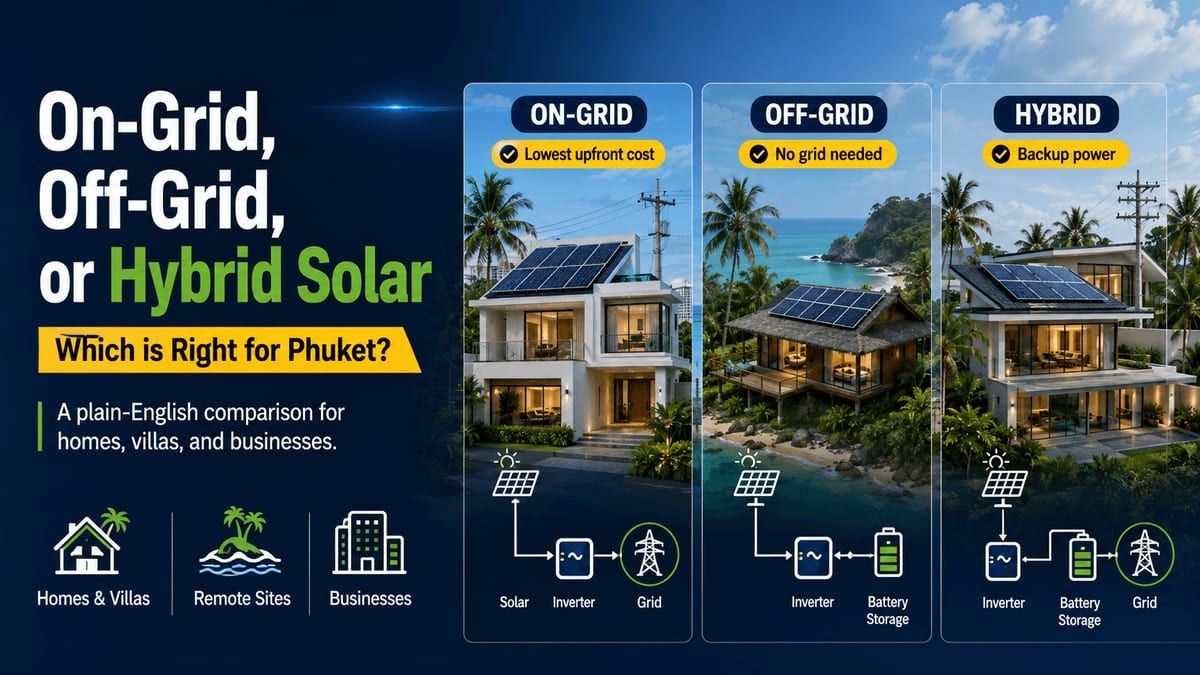
When you start researching solar, you quickly encounter three system types: on-grid, off-grid, and hybrid. Each works differently and suits different situations. Here is a clear breakdown — no technical jargon required.
On-Grid (Grid-Tied) — The Most Common Choice
Your solar panels connect directly to the electricity grid. During the day, solar powers your home first; any surplus is exported to PEA/MEA. At night or on cloudy days, you draw from the grid as normal. No batteries required.
- Lowest upfront cost — no battery expense
- Shortest payback period (4–7 years typically)
- Unlimited effective storage — the grid absorbs surplus and provides power at night
- Power cut = solar stops — inverter shuts off for safety during grid outages
Off-Grid — Complete Independence
No grid connection at all. Your solar panels charge a battery bank; the batteries power your home 24/7. This is the only option for remote locations without grid access — and is popular for islands, mountain properties, and agricultural land.
- Full independence — no electricity bills ever
- Works anywhere — no grid infrastructure needed
- Highest upfront cost — large battery bank required
- Requires careful system sizing — must cover worst-case cloudy days
Hybrid — The Best of Both
Connected to both the grid and a battery bank. Solar charges the battery first; when full, surplus exports to the grid. At night you use stored battery power; the grid is a backup for extended cloudy periods. Increasingly popular as battery prices fall.
- Backup power during grid outages — runs on battery
- Maximises self-consumption — store surplus instead of exporting at low rate
- Higher upfront cost than on-grid due to battery
- Longer payback than on-grid alone
Which System is Right for Phuket?
| Property Type | Recommended System | Why |
|---|---|---|
| Residential home | On-Grid | Stable grid, fast payback, no battery needed |
| Pool villa (owner-occupied) | On-Grid or Hybrid | Hybrid if you need backup power during outages |
| Holiday rental villa | On-Grid | Lower costs, higher property value, hassle-free |
| Hotel / resort | On-Grid (large) | High consumption — on-grid gives the best ROI |
| Remote home / land with no grid | Off-Grid | The only viable option |
| Need backup power / EV charging | Hybrid | Battery powers the night + backup |
Not sure which system suits your property? Our engineers assess your usage pattern, grid reliability, and budget — then recommend the system that delivers the best return.
Frequently Asked Questions
Does Phuket have frequent power cuts that make a battery worth it?
Phuket's grid is generally reliable, with outages mainly during severe storms. For most properties, on-grid is sufficient. Hybrid makes more sense for properties with critical equipment (medical devices, CCTV, data servers) or those in areas with less stable supply.
Can I upgrade from on-grid to hybrid later?
Yes, if you install a hybrid-ready inverter from the start. The cost of a hybrid inverter vs a standard inverter is modest, and it saves you from replacing the inverter entirely when you add batteries later. We recommend planning for this from day one.
What battery brands do you install?
We work with leading lithium LiFePO4 battery brands with proven track records in tropical climates. Ask our engineers for current recommendations based on your system size and budget during your consultation.
How much does adding batteries to a hybrid system cost?
Battery costs vary by capacity and brand. A 5 kWh LiFePO4 battery system typically starts from around 60,000–100,000 THB installed. Prices have been falling steadily and we expect further reductions in coming years.