
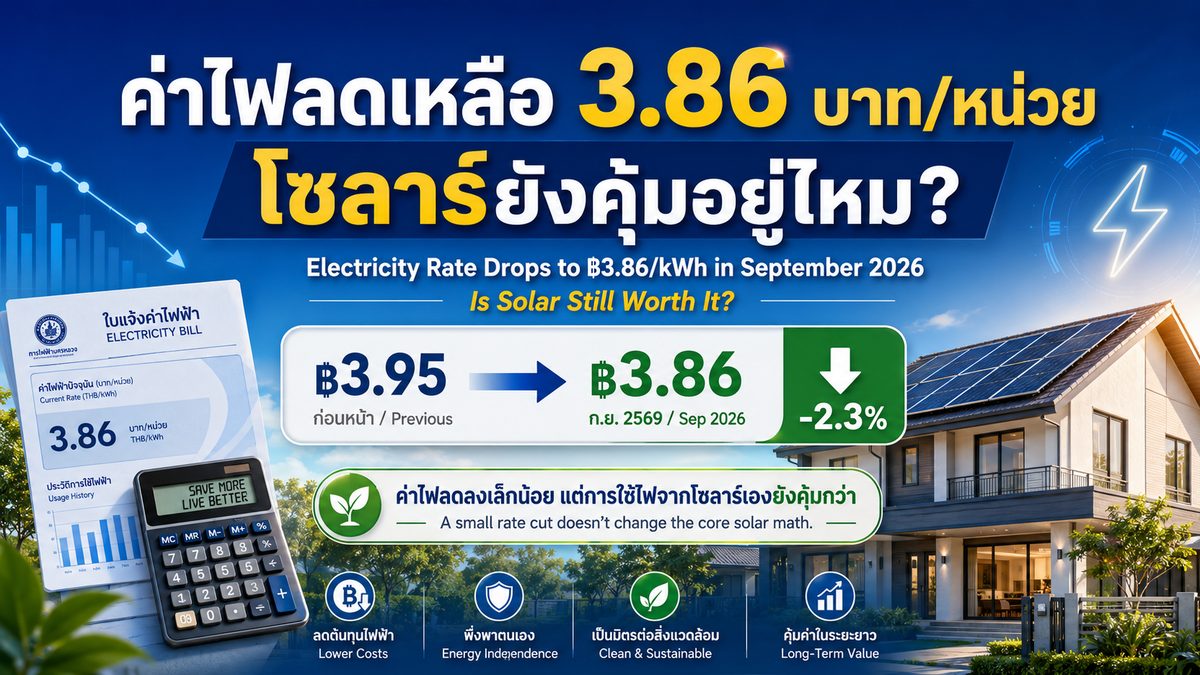
In August 2026, the Energy Regulatory Commission (ERC) announced a cut to the average residential electricity rate — from ฿3.95 to ฿3.86 per unit (kWh), effective the September 2026 billing cycle. The base tariff dropped from ฿3.78 to ฿3.69/unit. If you've been considering solar, a lower electricity rate naturally raises a question: does this change the math?
What actually changed
| Period | Average Rate | Base Rate |
|---|---|---|
| Jun–Aug 2026 · มิ.ย.–ส.ค. 2569 | ฿3.95/kWh · 3.95 บาท/หน่วย | ฿3.78/kWh · 3.78 บาท/หน่วย |
| From Sep 2026 billing cycle · เริ่มรอบบิล ก.ย. 2569 | ฿3.86/kWh · 3.86 บาท/หน่วย | ฿3.69/kWh · 3.69 บาท/หน่วย |
| Change · ส่วนต่าง | -฿0.09/kWh, ≈ -2.3% · ลดลง 0.09 บาท/หน่วย ≈ -2.3% | -฿0.09/kWh · ลดลง 0.09 บาท/หน่วย |
Figures reflect the ERC-announced average residential rate. Your actual rate varies by usage tier and time-of-use plan — check your bill for the exact figure.
Does a 2.3% rate cut change solar's payback?
Solar panels save you money by offsetting power you'd otherwise buy from the grid. A lower retail rate means every self-used kWh is worth slightly less than before — but the drop here is small. Every unit of solar power you use directly still saves you ฿3.86, only ฿0.09 less than in August. Over a 25-year system lifespan, a single 2.3% rate adjustment has a minor effect on total payback time compared to factors like system sizing and how much of your usage happens during daylight hours.
Why solar still makes sense
- Even at the lower rate, self-use (฿3.86) still beats the government sell-back rate (฿2.20) by a wide margin — the fundamental case for using power directly instead of exporting it hasn't changed.
- Retail electricity rates are reviewed periodically by the ERC and can move in either direction — a system built to last 25 years will see many such adjustments, not just this one.
- The sooner you install, the sooner you start saving — waiting for a "better" rate environment only delays the years of savings you'd otherwise be collecting.
Curious how the updated rate affects your specific payback timeline? We size every system around your actual usage pattern and current rates. Book a free consultation for an up-to-date estimate.
Frequently Asked Questions
Why did the electricity rate go down?
The ERC reviews and adjusts the Ft (fuel adjustment) component of the electricity tariff periodically based on fuel costs and other factors. The base rate also moved, from ฿3.78 to ฿3.69/unit, for the September 2026 billing cycle. Check the ERC's official announcements for the full breakdown of the adjustment.
Does this affect the ฿2.20/kWh solar sell-back program?
Not directly — the sell-back program runs on a separate fixed rate under a 10-year contract, independent of the periodic retail rate adjustments. See our related article on the sell-back program for details, and confirm the current terms with the utility when you apply.
Should I wait to see if rates drop further before installing solar?
Waiting doesn't protect you from rate changes in either direction, and it does delay the savings a working system would otherwise be generating. Since self-use savings still far outweigh the sell-back rate at today's ฿3.86/kWh, the case for installing sooner rather than later hasn't changed.