
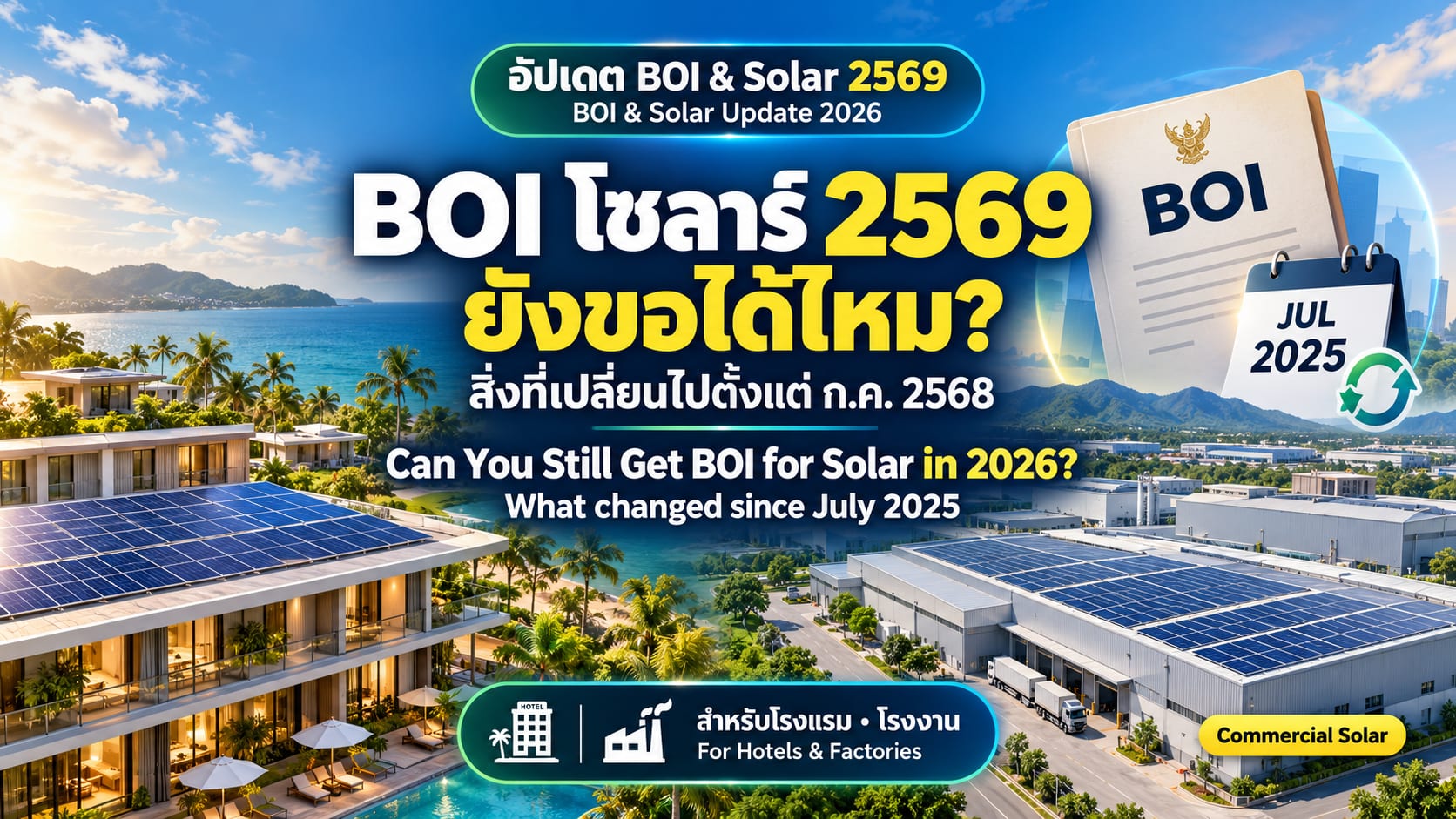
For years, "get BOI" was one of the strongest selling points for commercial rooftop solar in Thailand: a qualifying business could receive a corporate income tax exemption linked to the cost of its solar system. Many hotel and factory owners still ask us about it — and many websites still describe it as available. The rules changed in mid-2025, so this article explains what changed, what still qualifies, and how to plan a commercial solar project today.
In short: under BOI Announcement No. 3/2568 (issued 5 June 2025, effective 1 July 2025), BOI no longer grants investment promotion for installing solar power generation systems under its renewable-energy efficiency measure. This summary is based on published legal summaries of the announcement — always confirm your own case with BOI or a BOI consultant.
How the BOI solar incentive used to work
Under BOI's production-efficiency measures, an existing business in an activity eligible for BOI promotion could apply when it invested in solar to cut its own electricity use. Installer guides and BOI regional material from that period describe the benefit as a 3-year corporate income tax exemption capped at 50% of the eligible investment, with a minimum investment of around ฿1 million (excluding land and working capital), plus import-duty exemption on qualifying machinery.
It was never available to every business. The incentive applied to activities on BOI's promotion list — mainly manufacturing and certain services — which is why many hotels and resorts did not qualify even before the 2025 change.
What changed on 1 July 2025
- Solar installations removed: applications submitted from 1 July 2025 onward can no longer receive promotion for installing solar power generation systems under the renewable-energy efficiency measure.
- No extensions for earlier solar applications: according to the legal summaries, solar projects that applied before 30 June 2025 cannot extend the deadline to accept the promotion or to submit documents for the promotion certificate.
- Separately, in May 2025 BOI also stopped promoting solar cell and panel manufacturing to address oversupply — that concerns factories making panels, not businesses installing them.
What may still qualify
The renewable-energy efficiency measure itself was not cancelled. According to the published summaries, it can still cover modifying machinery to use renewable energy other than solar, and battery energy storage systems (BESS) and inverters, subject to an investment cap per MW of capacity set in the announcement. If you are planning a hybrid system with a large battery — for example at a resort that wants backup power — it is worth asking a BOI consultant whether the storage part could qualify. We don't promise BOI outcomes; eligibility is decided by BOI case by case.
You may also see "8-year tax exemption for solar" online. That refers to BOI's promotion categories for businesses that generate and sell electricity as their main activity — such as solar farms or energy companies — not to a hotel or factory installing solar on its own roof to cut its bill. Check the current BOI announcements before relying on it.
What this means for hotels, factories and businesses in Phuket
- If a proposal's payback depends on a BOI tax exemption for the solar system, ask the installer which announcement and clause it relies on. If they can't point to a current one, treat that benefit as zero.
- Judge the project on its own numbers: your real electricity bills, roof and daytime load. Commercial buildings that use most of their power during the day — hotels, factories, offices — still tend to make the strongest case for solar without any incentive.
- A solar system is a business asset, so it is normally handled through your company's regular accounting and depreciation. Ask your accountant how it applies to your business.
- The ฿200,000 personal income tax deduction for rooftop solar is for individuals with home systems, not companies — see our article on the solar tax deduction.
- Financing still matters more than incentives for most projects. Owning the system — by cash or a bank loan — usually keeps the most long-term value; see our guide to solar financing for hotels and factories.
Planning solar for a hotel, resort or factory? We'll design the system from your real bills and show the payback without counting on incentives that no longer apply — so the numbers hold up.
Frequently Asked Questions
Can my company still get BOI for rooftop solar in 2026?
Not under the renewable-energy efficiency measure — BOI stopped promoting solar installations under it for applications from 1 July 2025 (BOI Announcement No. 3/2568). Other parts of a project, such as battery storage, may still be eligible; confirm with BOI or a BOI consultant.
I already have a BOI certificate for my factory. Does that cover new solar?
An existing certificate covers the promoted activity it was issued for. Whether a new solar installation can be added depends on the current rules, and the July 2025 change removed solar from the efficiency measure. Check with your BOI consultant before assuming it is covered.
Is commercial solar still worth it without BOI?
For many businesses with high daytime electricity use, yes — the savings come from the electricity you no longer buy, not from the tax benefit. The answer depends on your bills, roof and usage pattern, so it's worth getting a design based on real data.
Does the ฿50,000 household solar subsidy apply to businesses?
The reported scheme targets households, not commercial projects. See our article on installing now versus waiting for the subsidy for the latest reported details.